A sharp kitchen knife makes cooking easier, faster, and safer. However, many home cooks continue using dull knives without realizing that a blunt blade can actually be more dangerous than a sharp one. When a knife loses its edge, it requires more pressure to cut, which increases the risk of slipping and accidents.
Learning how to sharpen a kitchen knife is a simple skill that can improve both safety and cooking efficiency. You don’t need to be a professional chef to restore a dull blade.
In this guide, you’ll learn how to sharpen a kitchen knife step by step, the tools you can use, and practical tips to keep your knives sharp for longer.
With the right technique and tools, sharpening a kitchen knife at home is easier than most people think.
How Do You Sharpen a Kitchen Knife?
To sharpen a kitchen knife, hold the blade at a 15–20° angle and slide it evenly across a sharpening stone or knife sharpener. Repeat the motion on both sides until a sharp edge forms. Then finish with a finer grit stone or a honing rod to refine the blade and improve cutting performance.
Quick Steps to Sharpen a Kitchen Knife
- Hold the knife at a 15–20° sharpening angle
- Slide the blade evenly across a sharpening stone
- Sharpen both sides of the blade
- Finish with a fine grit stone or honing rod
Sharpening works by removing a very small amount of metal from the blade. This process creates a new cutting edge that restores the knife’s performance.
When done correctly, sharpening makes food preparation easier, faster, and safer.
Why Sharp Kitchen Knives Matter
Many people believe that dull knives are safer. In reality, the opposite is true. A sharp knife cuts through food more easily and requires less force, which gives you better control while cooking.
When a knife is dull, you often need to push harder. This increases the chance that the blade may slip, which can lead to accidents in the kitchen.
Here are a few important reasons to keep your kitchen knives sharp:
- Improved safety: Sharp knives are less likely to slip while cutting food.
- Cleaner cuts: A sharp blade slices ingredients neatly instead of crushing them.
- Better cooking efficiency: You spend less time and effort preparing ingredients.
- Longer knife lifespan: Regular sharpening helps maintain the blade’s edge and overall performance.
Professional chefs sharpen their knives regularly because a well-maintained blade is one of the most important tools in the kitchen. Even for home cooks, learning how to sharpen a kitchen knife can make everyday cooking easier, safer, and more enjoyable.
Different knife materials and construction can also affect how quickly a blade becomes dull and how often it needs sharpening.
Signs Your Kitchen Knife Needs Sharpening
Even the best kitchen knives eventually lose their edge. Regular use slowly dulls the blade, especially when cutting tough ingredients or using hard cutting surfaces.
Learning to recognize the early signs of a dull knife helps you sharpen it before cutting becomes difficult or unsafe.
Different blade steel types and hardness levels can affect knife edge retention, which determines how long a kitchen knife stays sharp before it needs sharpening.
Here are some common signs that your kitchen knife needs sharpening:
1. The Knife Slips on Smooth Ingredients
If your knife struggles to cut foods like tomatoes, onions, or peppers, the blade is likely dull.
A sharp knife should grip the surface of the food and slice through it easily.
2. You Need to Use More Pressure
A sharp knife cuts with very little effort.
If you find yourself pushing harder to slice vegetables, meat, or fruit, the blade edge has probably become dull.
3. Food Gets Crushed Instead of Sliced
A dull knife often crushes delicate ingredients instead of slicing them cleanly.
For example, herbs may bruise and soft fruits may lose their shape. This can affect both the appearance and texture of your food.
4. The Paper Test Fails
A quick way to check knife sharpness is the paper test.
Hold a sheet of paper and try slicing it with your knife.
- Sharp knife: cuts smoothly through the paper
- Dull knife: snags, tears, or slides off the paper
If your knife struggles to cut the paper cleanly, it’s time to sharpen it.
How Knife Sharpening Works
To understand knife sharpening, it helps to know a little about the structure of a knife edge.
Even a brand-new knife is not perfectly smooth. Under a microscope, the blade edge has tiny grooves and teeth. Over time, these microscopic edges bend or wear down, which makes the knife feel dull.
Sharpening restores the blade by removing a small amount of metal and forming a new cutting edge.
Different types of knife steel can affect how easily a blade can be sharpened and how long it keeps a sharp edge.
The microscopic structure of knife edges explains why blades gradually lose sharpness during normal use.
Creating a New Edge
When you sharpen a knife on a whetstone or knife sharpener, the abrasive surface gradually removes a thin layer of metal from the blade.
This process reshapes the edge and creates a new, sharp bevel, which allows the knife to cut smoothly again.
Burr Formation
During sharpening, a small ridge of metal called a burr forms along the edge of the blade.
This burr is a sign that enough metal has been removed from one side of the knife. Once both sides are sharpened, the burr is refined or removed to produce a clean and sharp cutting edge.
Grit Progression
Sharpening stones come in different grit levels, which determine how coarse or fine the abrasive surface is.
| Grit Level | Purpose |
| 400–600 | Repair damaged or very dull edges |
| 800–1000 | Standard sharpening |
| 3000–6000 | Polishing and refining the edge |
Most home cooks start with a medium grit stone (around 1000 grit) for sharpening. Then they switch to a finer grit stone to polish and refine the blade.
Understanding how sharpening works helps you maintain the correct technique and prevents removing too much metal from the knife.
Tools You Can Use to Sharpen a Kitchen Knife
There are several tools you can use to sharpen a kitchen knife at home. The best option depends on your experience level, budget, and how often you sharpen your knives.
Some tools offer precise control, while others provide a faster and more beginner-friendly solution.
Below are the most common knife sharpening tools used by both home cooks and professional chefs.
Whetstone (Best for Precise Sharpening)
A whetstone, also known as a sharpening stone, is one of the most traditional and effective tools for sharpening kitchen knives.
It allows you to control the sharpening angle and refine the blade edge gradually using different grit levels.
Professional chefs often prefer whetstones because they can produce an extremely sharp and precise edge.
Many professional chefs prefer whetstones because they provide better control and produce extremely sharp edges.
Advantages of using a whetstone:
- Provides very precise sharpening results
- Works with both Western and Japanese knives
- Allows multiple grit levels for sharpening and polishing
- Produces a sharp, professional-quality edge
However, whetstones require a bit of practice. Maintaining a consistent sharpening angle while sliding the blade across the stone is the key to good results.
Many home cooks start with a 1000/3000 grit combination stone, which works well for both sharpening and finishing the blade.
Many home cooks choose the best whetstone for kitchen knives because it allows precise control over sharpening and produces a very sharp edge.
Manual Knife Sharpeners
Manual knife sharpeners are one of the easiest options for beginners. These tools usually have preset sharpening slots that guide the knife at the correct angle.
To sharpen the blade, simply pull the knife through the slot several times. Inside the sharpener are abrasive materials that grind the edge and restore sharpness.
Benefits of manual sharpeners:
- Very easy for beginners to use
- No need to control sharpening angles
- Quick sharpening process
- Affordable and compact
While manual sharpeners are convenient, they usually do not produce the same level of sharpness as a whetstone. Still, they work well for everyday home kitchens.
If you want a quick and beginner-friendly solution, exploring the best knife sharpeners can help you find tools that restore blade sharpness with minimal effort.
Electric Knife Sharpeners
Electric sharpeners use motorized abrasive wheels to sharpen knives quickly and consistently.
Many models include multiple stages, such as coarse grinding, sharpening, and polishing, which help refine the blade edge.
Advantages of electric sharpeners:
- Fast and convenient
- Requires very little skill
- Maintains a consistent sharpening angle
- Ideal for frequent knife maintenance
One downside is that electric sharpeners can remove more metal from the blade than manual methods. For this reason, they should be used carefully to avoid shortening the knife’s lifespan.
Honing Rod (Maintenance Tool)
A honing rod, also called a sharpening steel, is often misunderstood. Honing does not actually sharpen the knife by removing metal.
Instead, it realigns the microscopic edge of the blade, which can bend during normal use.
To better understand the difference between maintenance and sharpening, it helps to learn about honing vs sharpening and how each method affects knife performance.
Regular honing helps maintain sharpness between sharpening sessions.
Benefits of honing:
- Realigns the blade edge
- Helps knives stay sharp longer
- Quick and easy to use
- Reduces how often sharpening is needed
Many chefs quickly hone their knives before cooking to keep the blade edge properly aligned.
With the right sharpening tool, even beginners can restore a dull kitchen knife and improve its cutting performance.
In the next section, we’ll look at the step-by-step process for sharpening a kitchen knife using a whetstone, which is considered one of the most precise sharpening methods.
How to Sharpen a Kitchen Knife With a Whetstone
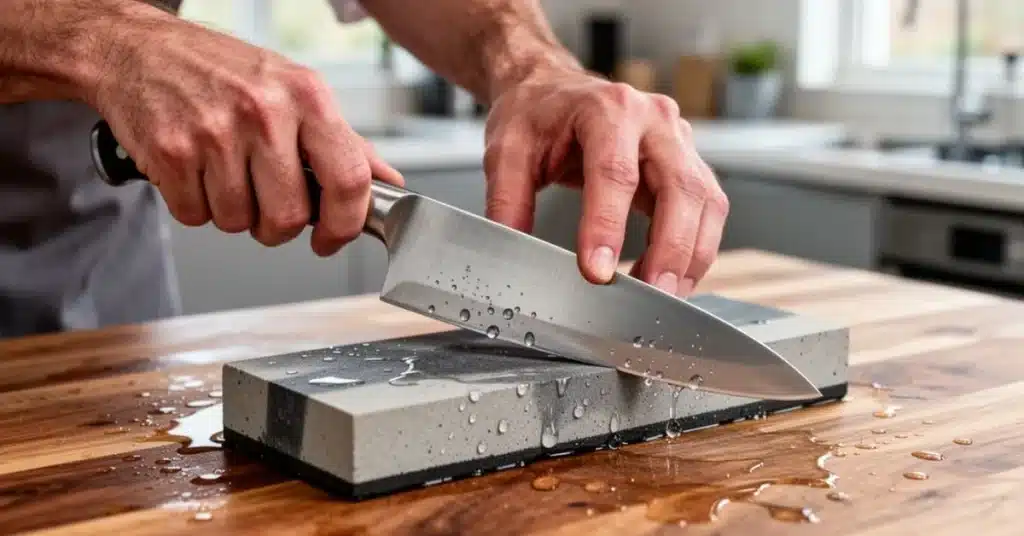
Sharpening a kitchen knife with a whetstone is one of the most effective ways to restore a dull blade. At first, the process may seem difficult. But once you understand the correct angle and motion, it becomes much easier.
Follow these simple steps to sharpen your kitchen knife safely and effectively.
Sharpening with a whetstone is a key part of proper knife sharpening and maintenance, especially for cooks who want to keep their blades performing at their best.
Step 1: Soak the Whetstone
Before sharpening, soak the whetstone in water for 10–15 minutes. This allows the stone to absorb water, which helps reduce friction and prevents the blade from overheating.
After soaking, place the stone on a stable surface. A cutting board or a damp towel works well to keep the stone from sliding.
Step 2: Set the Correct Sharpening Angle
The sharpening angle is one of the most important parts of the process. Most kitchen knives should be sharpened between 15° and 20°.
| Knife Type | Recommended Angle |
| Japanese knives | About 15° |
| Western knives | About 20° |
Keeping a consistent angle helps create a smooth and even cutting edge.
Step 3: Slide the Knife Across the Stone
Place the knife on the whetstone at the correct angle. Then gently slide the blade across the stone.
Use a motion similar to slicing a thin layer off the surface of the stone. Move the knife from the heel of the blade to the tip, making sure the entire edge touches the stone.
Apply light and even pressure during each stroke.
Step 4: Repeat on Both Sides
After sharpening one side of the blade several times, switch to the other side. This helps the edge develop evenly.
During sharpening, you may notice a small ridge called a burr forming along the blade edge. This is normal and means the metal is being reshaped properly.
Continue sharpening both sides until the knife begins to feel sharp again.
Step 5: Finish With a Fine Grit Stone
Once the blade edge has been sharpened, switch to a finer grit stone (around 3000–6000 grit). This step refines and polishes the edge for smoother cutting.
After sharpening, rinse the knife and dry it thoroughly before using it.
How to Sharpen a Knife Without a Whetstone
If you don’t have a whetstone, there are still a few ways to sharpen a kitchen knife at home. While these methods may not be as precise, they can restore some sharpness to a dull blade.
Using the Bottom of a Ceramic Mug
The rough ring on the bottom of a ceramic mug can act as a temporary sharpening surface.
Follow these steps:
- Turn the mug upside down.
- Hold the knife at a 15–20° angle.
- Slide the blade across the ceramic edge several times on each side.
This method can help restore a slightly dull knife when a sharpening stone is not available.
Using Sandpaper
Fine-grit sandpaper placed on a flat surface can also be used for sharpening. The process is similar to using a whetstone.
However, sandpaper wears out quickly, so it is usually considered a temporary solution.
Using a Manual Knife Sharpener
Manual knife sharpeners are one of the easiest options for beginners. Simply place the blade into the sharpening slot and pull it through several times.
If you prefer a quicker solution, many home cooks use manual knife sharpeners, which are commonly featured in guides to the best knife sharpeners for home kitchens.
This method is quick and convenient, although it may not produce the same level of sharpness as whetstone sharpening.
By following these methods, you can restore the cutting performance of your kitchen knife and make food preparation much easier.
In the next section, we’ll look at important safety tips and practical techniques that help maintain a consistent knife edge.
Knife Sharpening Safety Tips
Sharpening a kitchen knife means working with a very sharp blade, so safety should always come first. Using the right setup and technique helps reduce the risk of accidents while sharpening.
Below are some simple safety tips to follow when sharpening knives at home.
For a more complete guide on handling knives safely in the kitchen, it’s helpful to follow proper knife safety tips and storage guide practices.
Use a Stable Surface
Always place your whetstone or knife sharpener on a stable, non-slip surface. A moving stone can make the blade slip and cause injury.
Many people place a damp towel under the whetstone to keep it steady during sharpening.
Maintain a Secure Grip
Hold the knife firmly by the handle and keep your fingers away from the cutting edge.
A secure grip gives you better control over the blade and helps you maintain a consistent sharpening angle.
Apply Light Pressure
Avoid pressing too hard while sharpening. Instead, use light and steady pressure.
This allows the stone to remove metal evenly and reduces the risk of the blade slipping.
Work Slowly and Carefully
Sharpening is not something you should rush. Use slow, controlled strokes to keep the blade stable and maintain the correct angle.
Working slowly also helps prevent accidental cuts.
Keep the Blade Facing Away From You
Whenever possible, move the blade away from your body while sharpening.
This simple habit greatly reduces the chance of injury if the knife slips.
According to professional kitchen safety guidelines, using a sharp knife actually reduces the risk of accidents because it requires less force while cutting.
Best Angle to Sharpen a Kitchen Knife
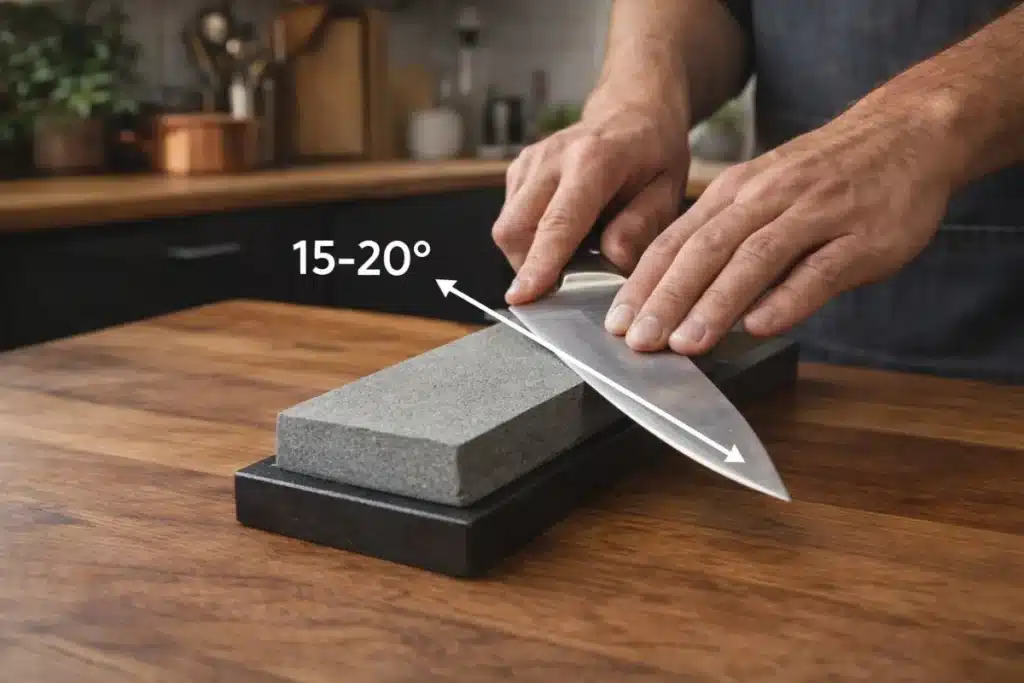
Maintaining the correct sharpening angle is one of the most important factors for creating a sharp and durable knife edge.
Most kitchen knives are sharpened at an angle between 15° and 20°. The exact angle depends on the type of knife you are using.
The recommended sharpening angle can vary depending on the knife style, which is why understanding the differences between Japanese vs Western knives is helpful for choosing the right sharpening technique.
| Knife Type | Recommended Angle |
| Japanese knives | About 15° |
| Western knives | About 20° |
A smaller angle creates a sharper edge, which is great for precision cutting. However, the edge may wear down faster.
A slightly wider angle makes the blade more durable and better suited for heavy use.
For beginners, the most important thing is consistency. Even if the angle is not perfectly exact, keeping the same angle during each stroke will produce better sharpening results.
How Often Should You Sharpen Kitchen Knives?
How often you sharpen a kitchen knife depends on how frequently you use it and the types of ingredients you cut.
Knives used every day will naturally lose their edge faster than knives used occasionally.
Regular kitchen knife maintenance, including sharpening and honing, helps extend the life of your blade and keeps it cutting efficiently.
Here is a general sharpening guideline for most home kitchens:
| Usage Level | Recommended Sharpening Frequency |
| Home cooks | Every 2–3 months |
| Frequent cooks | About once a month |
| Professional chefs | Every 1–2 weeks |
Keep in mind that sharpening is not something you need to do every time you cook. Instead, you should sharpen the knife when it starts to feel dull or requires more pressure while cutting.
Regular honing can help maintain the blade between sharpening sessions. Honing does not remove metal but simply realigns the knife’s edge, allowing the blade to cut efficiently for a longer time.
Common Knife Sharpening Mistakes to Avoid
Many beginners struggle with knife sharpening because of a few common mistakes. Avoiding these errors can help you sharpen knives more effectively and protect the blade from unnecessary damage.
Here are some of the most common knife sharpening mistakes.
Understanding common knife sharpening mistakes can help beginners improve their sharpening technique and avoid damaging the blade edge.
Using the Wrong Angle
Sharpening at an inconsistent or incorrect angle can damage the blade edge. It may also cause the knife to become dull again quickly.
For best results, maintain a consistent sharpening angle during each stroke.
Applying Too Much Pressure
Pressing too hard against the stone removes more metal than necessary. Over time, this can shorten the lifespan of your knife.
Instead, use light and steady pressure while sharpening.
Skipping the Fine Grit Stone
Some people stop sharpening after using a coarse stone. However, finishing with a fine grit stone helps polish the edge and improves cutting performance.
This final step makes the knife smoother and sharper.
Sharpening Too Frequently
Sharpening removes metal from the blade edge. Doing it too often can gradually wear down the knife.
It’s better to sharpen only when the blade becomes dull, rather than sharpening after every use.
Using the Wrong Cutting Surface
Cutting on hard surfaces like glass, marble, or stone countertops can dull a knife very quickly.
To maintain sharpness longer, use a wooden or rubber cutting board instead.
By avoiding these common mistakes, you can sharpen your kitchen knives more safely and effectively. Proper sharpening technique also helps protect both the blade and your hands.
In the next section, we’ll explore the difference between honing and sharpening, and how each method helps maintain a knife’s edge.
Honing vs Sharpening (What’s the Difference?)
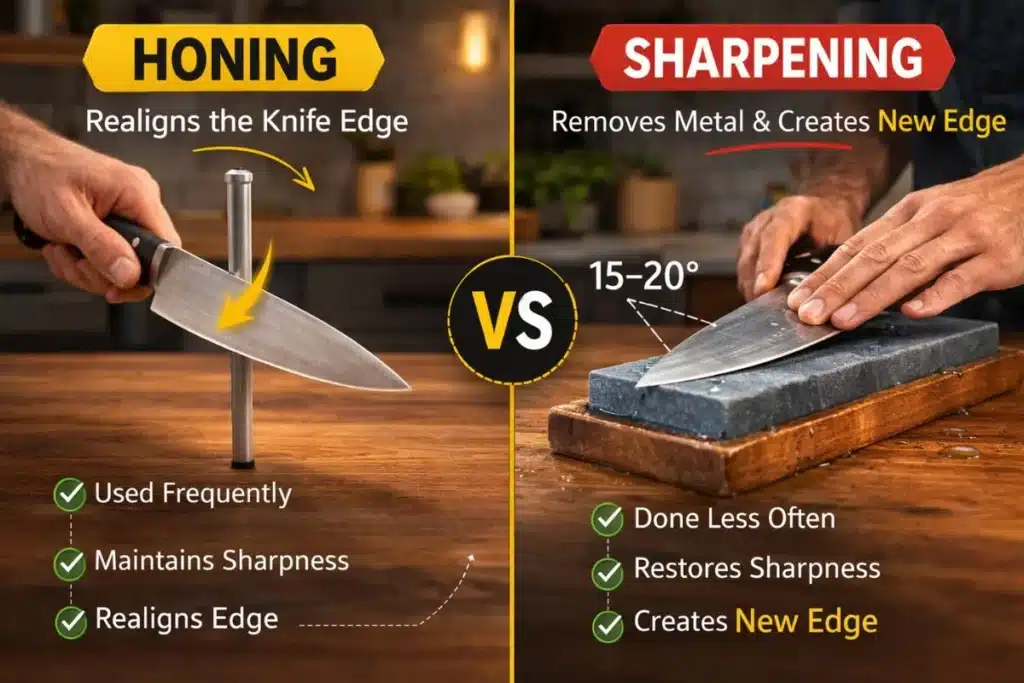
Many people confuse honing with sharpening, but they are actually two different processes. Both help maintain a knife’s performance, but they work in different ways.
For a more detailed explanation of these two techniques, you can explore a complete honing vs sharpening guide that explains how each method affects knife performance.
| Honing | Sharpening |
| Realigns the blade edge | Removes metal to create a new edge |
| Used frequently | Done less often |
| Maintains sharpness | Restores sharpness |
When you use a knife regularly, the blade edge can bend slightly, even if it isn’t completely dull yet. A honing rod straightens this edge so the knife can cut properly again.
Sharpening, on the other hand, removes a small amount of metal from the blade to create a completely new cutting edge.
For most home cooks, the best knife maintenance routine is simple:
- Hone the knife regularly to keep the edge aligned.
- Sharpen the knife every few months when the blade becomes dull.
Using both methods together helps keep your kitchen knives sharp, efficient, and ready for everyday cooking.
Recommended Knife Sharpening Tools
Using the right sharpening tool can make the process much easier, especially for beginners. While professional chefs often prefer whetstones, many home cooks find manual or electric sharpeners more convenient.
Below are some of the most common knife sharpening tools used in home kitchens.
- Whetstones: Ideal for precise sharpening and professional-quality edges.
- Manual knife sharpeners: Beginner-friendly and simple to use.
- Electric sharpeners: Fast and convenient for regular knife maintenance.
- Honing rods: Useful for maintaining the blade edge between sharpening sessions.
Each tool offers different advantages depending on your experience level and sharpening needs.
If you’re looking for reliable options, you can explore guides on the best knife sharpeners and the best whetstones for kitchen knives to find tools that fit your cooking style and budget.
How to Keep Your Kitchen Knife Sharp Longer
Sharpening your knife regularly is important. However, proper care and maintenance can help the blade stay sharp for a much longer time.
By following a few simple habits, you can extend the life of your kitchen knives and reduce how often they need sharpening.
For more detailed care techniques, you can follow a complete kitchen knife maintenance guide that explains how to properly sharpen, hone, and store your knives.
Use the Right Cutting Board
Avoid cutting on hard surfaces such as glass, marble, or ceramic. These materials can dull the knife edge very quickly.
Instead, use wooden or rubber cutting boards, which are much gentler on the blade.
Wash Knives by Hand
Dishwashers can damage knife edges because of high heat and movement during the wash cycle.
For better care, wash your knives by hand and dry them immediately after cleaning.
Store Knives Properly
Throwing knives loosely into a drawer can damage the blade and increase the risk of injury.
A safer option is to store knives using:
- a knife block
- a magnetic strip
- blade guards
These storage methods protect both the knife and your hands.
Hone Your Knife Regularly
Using a honing rod every few cooking sessions helps keep the blade edge aligned.
Regular honing maintains sharpness and reduces how often you need to sharpen your knife.
With proper care and maintenance, a good kitchen knife can remain sharp, reliable, and effective for many years.
Kitchen Knife Sharpening FAQs
How do you sharpen a kitchen knife at home?
You can sharpen a kitchen knife at home using a whetstone, manual sharpener, or electric sharpener. Hold the knife at a 15–20° angle and slide the blade evenly across the sharpening surface. Repeat the motion on both sides until the edge becomes sharp, then finish with a finer grit stone or honing rod.
What angle should you sharpen a kitchen knife?
Most kitchen knives should be sharpened at an angle between 15° and 20°. Japanese knives typically use a 15° angle for a sharper edge, while Western knives are usually sharpened at around 20° for better durability.
What is the best way to sharpen a kitchen knife?
The best way to sharpen a kitchen knife is by using a whetstone. Whetstones allow precise control over the sharpening angle and gradually refine the blade edge using different grit levels. This method can produce a sharper and more durable edge than most manual or electric sharpeners.
Can you sharpen a knife without a sharpener?
Yes, in some situations you can sharpen a knife without a sharpener. The rough ceramic ring on the bottom of a mug or fine sandpaper can act as a temporary sharpening surface. However, proper sharpening stones or knife sharpeners usually provide better and more consistent results.
How often should kitchen knives be sharpened?
For most home cooks, sharpening kitchen knives every 2–3 months is usually enough. If you cook frequently, you may need to sharpen them about once a month. Professional chefs often sharpen their knives every 1–2 weeks, depending on how often they are used.
What grit whetstone is best for beginners?
A 1000 grit whetstone is typically recommended for beginners because it provides effective sharpening without removing too much metal. Many people also use a 1000/3000 combination stone to sharpen the blade and then polish the edge.
Is it better to sharpen or hone a knife?
Sharpening and honing serve different purposes. Honing realigns the knife edge and helps maintain sharpness during regular use. Sharpening removes a small amount of metal to create a new edge and is usually done every few months when the blade becomes dull.
Final Thoughts on Sharpening Kitchen Knives
Learning how to sharpen a kitchen knife is a valuable skill for any home cook. A sharp knife makes food preparation easier, safer, and more efficient in the kitchen.
By using the right tools and maintaining the correct sharpening angle, you can restore the cutting performance of even a dull blade. Regular sharpening and proper knife care also help extend the lifespan of your kitchen knives.
Whether you use a whetstone, a manual sharpener, or another sharpening method, the key is to maintain consistent technique and care for your knives properly.
With the methods and tips explained in this guide, sharpening a kitchen knife at home becomes simple and practical for everyday cooking.
With regular sharpening and proper maintenance, your kitchen knives will stay sharp, safe, and ready for every meal you prepare.