
If you’ve ever struggled with slicing vegetables cleanly or wished you could cut faster without bruising delicate produce, a Nakiri knife is the tool you’ve been missing. This traditional Japanese vegetable knife is designed for precision, speed, and ultra-smooth cuts, making it a favorite among both home cooks and professional chefs.
With its straight, flat blade, the Nakiri slices all the way through vegetables without rocking, giving you perfectly even cuts every time. Whether you’re chopping onions, shredding cabbage, or making ultra-thin slices of cucumbers, the Nakiri delivers consistently beautiful results.
In this Ultimate Guide (2025), you’ll learn:
- ✔ What a Nakiri knife is and how it works
- ✔ Every common use — from vegetables to garnish work
- ✔ How to use it correctly (step-by-step)
- ✔ Nakiri vs Chef Knife vs Santoku Knife
- ✔ Pros & cons you should know before buying
- ✔ Safety tips, maintenance, and sharpening
- ✔ How to choose the best Nakiri for your kitchen
If you want cleaner slices, faster prep time, and a knife that feels effortless with vegetables — the Nakiri might become your new favorite kitchen tool.
If you want cleaner cuts and a better overall knife setup in your kitchen, make sure you also check out my guide on the best kitchen knives for 2025. It shows which knives pair well with a Nakiri and how each one improves your cooking experience.
What is a Nakiri Knife?
When people hear the word Nakiri knife, they often ask: what makes it different from other knives? A Nakiri bōchō (菜切り包丁) means “leaf cutter” in Japanese (Wikepedia). The name shows its true purpose—cutting vegetables. For centuries, this knife has been a favorite tool for Japanese home cooks and professional chefs. To see where the Nakiri fits compared to other blades, check my guide on knife types and uses.
Japanese Roots of the Nakiri
Japan has a long tradition of vegetable-based meals, and the Nakiri was made to serve that need. Unlike the Usuba knife (a single-bevel blade used only by trained chefs), the Nakiri was built for everyday cooking.
- Its double-bevel edge works for both right-handed and left-handed cooks.
- The design made it simple and practical for home kitchens.
Because of this, the Nakiri became a staple knife in Japanese households, especially where seasonal vegetables play a central role. If you’re curious how Japanese blades compare to Western ones, read my breakdown of Japanese vs Western knives.
Blade Design
The Nakiri stands out because of its unique blade structure:
- Rectangular blade → Flat and tall, looks like a small cleaver. This adds stability.
- Double-bevel edge → Sharpened on both sides, user-friendly for everyone.
- Flat edge → Made for a push-cut motion, not rocking, which gives neat and even slices.
This design makes chopping easier. Every stroke touches the board fully, so vegetables are cut cleanly without extra effort. The steel and construction also matter a lot for edge retention and durability — I break this down in my full guide on knife materials and construction.
Want to keep that blade razor-sharp? Check out the Serious Eats guide on sharpening a knife with a whetstone.
How It Differs from Western Knives
A Western Chef’s knife usually has a curved edge designed for a rocking motion. While this style works for mincing garlic or herbs, For more details on how you should actually use a Western chef’s blade, see my full guide on how to choose the right kitchen knife.it can also:
- Bruise delicate greens like spinach
- Crush soft produce such as tomatoes
The Nakiri’s flat edge solves these issues. Every chop goes straight down, making full contact with the board. This leads to:
- Cleaner slices
- Faster prep time
- Vegetables that keep their texture and look fresh
Quick Answer: A Chef’s knife is versatile and all-purpose, but the Nakiri is a vegetable specialist—built to respect fresh produce and give exact, clean cuts. Smaller precision work is usually better with a paring blade — here’s what paring knives are used for.
Want to explore more kitchen tools? Check my guides on Is Ceramic Cookware Safe? or Cake Pan vs Pie Pan: What’s the Real Difference?
What is a Nakiri Knife Used For in the Kitchen?
A Nakiri knife is made for one job—vegetable preparation. It makes cutting produce faster, cleaner, and more precise. Unlike all-purpose knives, the Nakiri’s design focuses only on chopping vegetables with accuracy.
Chopping Vegetables
The Nakiri is perfect for everyday produce such as:
- Leafy greens like spinach, lettuce, and kale
- Cucumbers and zucchinis
- Soft vegetables like tomatoes
Because the blade is flat, each chop goes straight through the vegetable in one smooth motion. No rocking, no uneven cuts—just clean slices every time.
Dicing and Slicing Herbs
Herbs often lose flavor when crushed by a curved knife. The Nakiri avoids this problem with its sharp, flat edge.
- Works well for parsley, cilantro, basil, and scallions
- Keeps herbs fresh, bright, and flavorful
- Cuts finely without damaging delicate leaves
Cutting Larger Vegetables
Don’t be fooled by its slim look—the Nakiri handles tough vegetables too.
- Easily chops carrots, radishes, and turnips
- Cuts through harder produce like sweet potatoes and squash
- Its tall blade adds stability and power when slicing firm items
Scooping & Scraping
The Nakiri’s flat, tall blade is also handy after chopping. You can:
- Scoop up diced vegetables quickly
- Transfer them directly to a pan or bowl
- Scrape the cutting board gently without leaving scratches
Quick Answer: A Nakiri knife is used to chop, slice, and dice vegetables with precision. It works well for leafy greens, herbs, and larger vegetables such as carrots or squash.
If you want to see where the Nakiri sits among all your kitchen knives, check my best kitchen knives guide.
Best Foods to Use a Nakiri Knife On
A Nakiri knife truly shines when you’re working with vegetables. Its thin blade slices through produce with zero resistance, helping you achieve smooth, even cuts.
Here are the foods it works best on:
Leafy Greens
- Spinach
- Cabbage
- Napa cabbage
- Lettuce
The straight blade helps make wide, clean vegetable ribbons.
Root Vegetables
- Carrots
- Potatoes
- Beets
- Daikon radish
It cuts dense vegetables without cracking or splitting.
Soft Vegetables
- Tomatoes
- Eggplants
- Zucchini
A thin Japanese edge prevents squishing.
Herbs & Aromatics
- Garlic
- Ginger
- Scallions
- Basil
- Mint
The Nakiri gives consistent fine chopping for garnishes.
Fruit
- Apples
- Pears
- Mango (after peeling)
- Melons (for slicing)
Perfect when you need precision without bruising the flesh. For jobs that are too tiny even for a Nakiri, a small paring knife is often the better choice — here’s what a paring knife is used for.
Can You Cut Meat with a Nakiri Knife? (Myth vs Reality)
Designed for Vegetables
The Nakiri knife was created for vegetables, not meat. Its flat, rectangular blade has no curve or pointed tip. This makes it excellent for straight chopping but less effective for cutting meat fibers or bones. Using it on heavy proteins can dull or even damage the blade.
When It’s Okay
Even though it isn’t made for meat, the Nakiri can still handle a few light protein tasks:
- Slicing boneless chicken breasts
- Cutting fish fillets
- Trimming soft, cooked meat
These tasks are fine once in a while. But if you prepare meat often, the Nakiri should not be your main knife.
Better Alternatives for Meat
For meat prep, other knives work better:
- Chef’s Knife → A versatile, curved blade for steaks, trimming fat, and everyday cooking.
- Cleaver → A strong, heavy knife designed to split bones and chop thick cuts with ease.
The Nakiri shines with vegetables, but for meat, these knives are safer and more efficient.
You can also read my guides on [What is a Boning Knife Used For?] and [Fillet Knife vs Boning Knife: Key Differences & Best Uses 2025] to choose the right knife for meat tasks.
Comparison Table: Nakiri vs Chef Knife vs Cleaver
| Knife Type | Best For | Not Good For |
| Nakiri | Vegetables, herbs | Bones, thick meat cuts |
| Chef Knife | Meat, all-purpose cooking | Thin veggie precision |
| Cleaver | Bones, heavy chopping | Fine slicing or detail work |
Quick Answer: A Nakiri knife can cut soft proteins like boneless chicken or fish, but it is not designed for meat or bones. For meat, a Chef’s knife or Cleaver is the better choice.
Pro Tip: Many home cooks pair a Nakiri for vegetables with a Chef’s knife or Cleaver for meat. This way, you cover both needs in the kitchen.
Nakiri vs Santoku vs Chef Knife – Which is Better?
When it comes to kitchen knives, many home cooks compare the Nakiri, Santoku, and Chef’s knife. Each knife has its own strengths, design, and best use. Understanding these differences will help you choose the right tool for your cooking needs.
Blade Design Differences
- Nakiri → Rectangular, flat blade designed mainly for vegetables.
- Santoku → Shorter, versatile knife called the “three virtues”—meat, fish, and vegetables.
- Chef’s Knife → Curved, long Western-style blade made for all-purpose cooking.
Takeaway: The Nakiri specializes in vegetables, the Santoku balances between meat and veggies, while the Chef’s knife excels in versatility.
Cutting Motion
- Nakiri → Straight push cut, no rocking needed.
- Santoku → Slight rocking combined with chopping.
- Chef’s Knife → Full rocking motion, great for slicing and mincing.
Because of these differences, each knife feels different in hand. Beginners often find the Nakiri easier, while professionals often prefer the Chef’s knife for flexibility.
Best Use-Cases
- Nakiri → Daily vegetable prep, herbs, leafy greens, and larger produce like squash.
- Santoku → A multitasking knife for home cooks, works well with meat, fish, and vegetables.
- Chef’s Knife → Ideal for meat prep, large cuts, and Western-style cooking.
Comparison Table: Nakiri vs Santoku vs Chef Knife
| Knife Type | Best For | Limitations |
| Nakiri | Vegetables, herbs, precision cuts | Not suited for meat or bones |
| Santoku | All-purpose (meat, fish, veggies) | Less rocking, shorter blade |
| Chef’s Knife | Meat, heavy-duty, versatile use | Less precise for thin vegetables |
Want to dive deeper into knife comparisons?
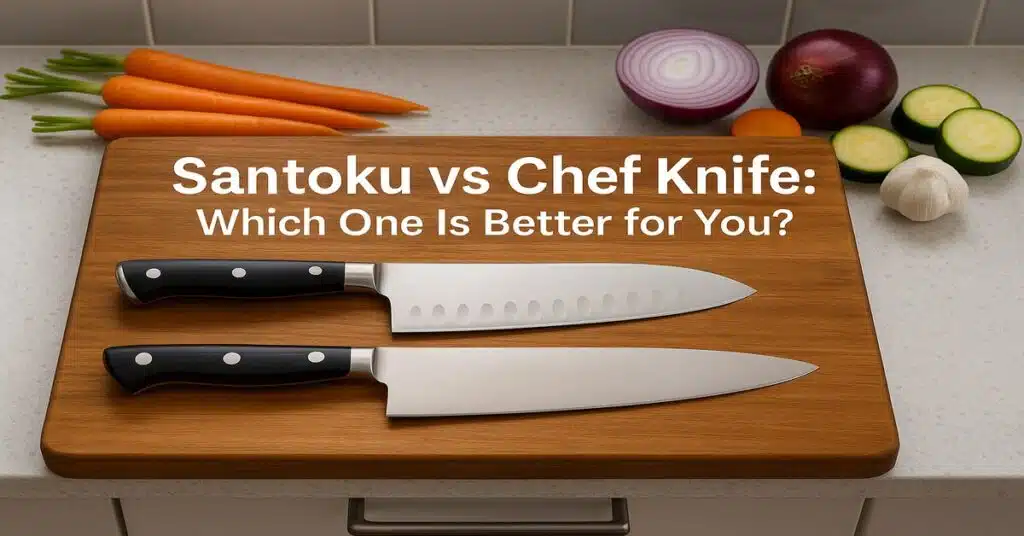
Check out my detailed guide on [Santoku vs Chef Knife: Which One Is Better for You?]and also learn [What Are Paring Knives Used For?] to understand how smaller knives fit into your kitchen toolkit.
Quick Answer: A Nakiri is best for vegetables, a Santoku is a versatile all-rounder, and a Chef’s knife is the top choice for meat and Western cooking.
For a trusted comparison, read Nakiri vs. Santoku Knife: The Main Difference
Pros and Cons of a Nakiri Knife
Pros
- Exceptional for slicing vegetables
- Very thin, sharp blade for precision
- Straight edge makes chopping faster
- Wide blade helps scoop ingredients
- Less wrist movement needed
Cons
- Not suitable for meat or bone
- Thin blade can chip with misuse
- Requires careful storage
- Some beginners prefer a curved knife
Many of these pros and cons apply to other blades too — especially when you look at knife materials and construction.
See my detailed guide on knife materials and construction to understand how steel type, hardness, and blade design affect performance.
Common Mistakes to Avoid
- Rocking the knife like a chef’s knife
- Cutting frozen or bone-in items
- Dropping the knife on hard surfaces
- Dragging the edge sideways on cutting board
- Using a glass or marble board (kills sharpness fast)
- Not drying after washing (rust risk for carbon steel)
These mistakes reduce sharpness and cause chips. To avoid injuries and keep every blade safe to use, make sure you follow these essential kitchen knife safety tips.
For more official guidance on safe food and knife handling, review the FDA food safety guidelines or the USDA’s kitchen safety recommendations.
Is a Nakiri Knife Good for Beginners or Chefs?
The Nakiri knife isn’t just popular in Japan—it’s now loved by cooks worldwide. From beginners to professionals, many people prefer it because it makes vegetable prep simple, fast, and precise.
Home Cooks
For new cooks, the Nakiri is one of the easiest knives to start with. Its flat blade and push-cut motion mean you don’t need advanced knife skills. Just press down, and you’ll get neat, even slices every time.
Vegetarian and Vegan Families
If vegetables are the main part of your meals, the Nakiri can save you time and effort. It helps you:
- Chop leafy greens without bruising them
- Slice root vegetables like carrots and potatoes smoothly
- Dice large amounts of produce quickly and evenly
For plant-based diets, this knife is almost a must-have—it keeps veggies fresh and attractive.
Professional Chefs
Even in professional kitchens, the Nakiri is trusted for its speed and precision. Chefs use it for large-scale vegetable prep because its flat edge cuts faster and more consistently than a curved Chef’s knife. It’s especially useful in Japanese and plant-focused restaurants.
Quick Checklist: Who Should Use a Nakiri?
- Beginners – Easy learning curve
- Veggie lovers – Perfect for plant-based meals
- Chefs – Reliable for speed and precision
- Meat lovers – Better off with a Chef’s knife or Cleaver
Quick Answer: Yes, a Nakiri knife is good for both beginners and chefs. Home cooks love it for easy veggie prep, while professionals value it for speed and precision.
Why Use a Nakiri Knife? Benefits Explained
The Nakiri isn’t just another kitchen knife—it brings real, everyday value to cooking. From cleaner cuts to better-looking dishes, here’s why I recommend it.
Precision Cutting – Clean Cuts Without Bruising
One of the Nakiri’s biggest strengths is its ability to slice vegetables cleanly. Unlike curved knives that can squash or bruise delicate produce, the flat blade goes straight down.
- Leafy greens stay fresh and crisp
- Tomatoes hold their shape instead of turning mushy
- Herbs look neat and unbruised
If you like your veggies to look as good as they taste, this knife is a must-have.
Faster Meal Prep
Because each chop goes through in one smooth motion, you save time. You don’t need to rock the blade or make multiple cuts.
- Prepping large batches of vegetables becomes effortless
- Cooking feels faster and more fun
From my own experience, this single benefit alone has saved me countless minutes in the kitchen.
Less Waste – Better Yield From Vegetables
A Nakiri doesn’t crush vegetables or squeeze out juice. That means:
- More usable portions from every ingredient
- Less food sticking to the blade
- No more throwing away squashed or uneven pieces
This knife not only helps your cooking—it also saves money over time.
Aesthetic Presentation of Food
Uniform cuts make meals look professional. Whether you’re preparing a salad, stir-fry, or garnish:
- Pieces look even and balanced
- Dishes plate beautifully
- Your food impresses guests and family alike
After switching to a Nakiri, I noticed my meals looked restaurant-quality—without any extra effort.
Quick Answer: A Nakiri knife gives clean, precise cuts, speeds up prep, reduces waste, and makes food look better on the plate.
If you’re building a full set, I share my top picks for different budgets in this best kitchen knives 2025 guide.
Here’s my tip:
If vegetables are a big part of your meals, try using a Nakiri knife. You’ll notice the difference from the very first chop—cleaner cuts, faster prep, and meals that look as good as they taste.
How to Use and Care for a Nakiri Knife (Hands-On Tips)
The Nakiri knife makes vegetable prep simple, but using it correctly will give you the best results and keep it sharp for years. Based on my own cooking experience, here’s how to handle, maintain, and store it properly.
Proper Grip & Push-Cut Motion
The Nakiri is designed for a push-cut motion, not a rocking cut like a Chef’s knife.
- Hold the handle firmly with your dominant hand.
- Use your other hand to steady the vegetable.
- Push the blade straight down and slightly forward.
This gives clean cuts and reduces strain on your wrist.
Best Cutting Boards for Nakiri
Your cutting board matters as much as your knife. The wrong board can damage your edge.
- Best choice: Wood or bamboo boards → gentle on the blade and long-lasting.
- Good option: High-quality plastic → easy to clean, safe for daily use.
- Avoid: Glass, marble, or ceramic → they dull the blade quickly.
From my experience, a bamboo board gives the best balance of durability and blade safety.
Sharpening & Maintenance
A sharp Nakiri is safer and more enjoyable to use.
- Sharpening tool: Use a whetstone instead of a honing rod.
- Angle: 15°–17° for Japanese knives.
- Frequency: Every 2–3 months if used often.
Pro tip: After sharpening, rinse and dry the knife immediately to protect the edge.
Remember, honing and sharpening aren’t the same—honing just realigns the edge, while sharpening actually grinds new metal. Learn more here: Honing vs. Sharpening – Serious Eats.
Storage & Safety Practices
Proper storage keeps your Nakiri safe and sharp.
- Best storage: Knife block, magnetic strip, or a sheath.
- Never do: Don’t leave it loose in a drawer—it can chip or cause accidents.
- Extra care: Always hand-wash and dry right after use. Avoid soaking in water.
Key Takeaway: To keep your Nakiri sharp and reliable, use a push-cut motion, pair it with a wood or bamboo board, sharpen it with a whetstone, and store it safely in a block or strip. Try this yourself—you’ll notice your Nakiri stays sharper, lasts longer, and makes prep much easier. For professional-level cutting techniques, the Culinary Institute of America offers excellent tutorials on proper knife handling.
Best Nakiri Knives in 2025 (Buyer’s Guide)
If you’re planning to buy a Nakiri knife in 2025, you’ll find plenty of choices. From premium Japanese brands to durable German options, the market has something for every cook. Based on my personal kitchen experience and research, here are the best options.
Top Brands for Nakiri Knives
- Shun → Premium Japanese craftsmanship with razor-sharp blades and elegant pakkawood handles. Great for serious cooks.
- Dalstrong → Affordable and stylish. A good choice if you want modern design with Japanese-style performance.
- Global → Lightweight, stainless steel build. Perfect for chefs who like balance and easy handling.
- Zwilling / Wüsthof → German brands known for durability and ergonomic comfort. Ideal for Western kitchens.
Takeaway: Shun and Global are best for authentic Japanese style, while Dalstrong and Zwilling offer value and everyday durability.
Price Ranges in 2025
- Budget ($50–$80) → Best for beginners. Basic stainless steel blades with simple handles.
- Mid-range ($90–$150) → Balanced choice. High-carbon stainless steel, ergonomic handles, and long-lasting sharpness.
- Premium ($200+) → Handcrafted Japanese knives with Damascus steel, unique finishes, and professional-level performance.
From my experience: If you’re starting out, go mid-range—it gives the best balance of sharpness, comfort, and durability. You can also compare independent knife test results from America’s Test Kitchen to see how different Nakiri models perform.
Buying Tips for Nakiri Knives
- Handle comfort → Look for an ergonomic grip that feels safe and balanced.
- Blade steel → High-carbon stainless steel stays sharp longer and resists rust.
- Weight & balance → A good Nakiri should feel light enough for speed but tall enough for stability.
- Warranty & reviews → Always check return policies and what other cooks are saying.
My Tip: Always invest in quality steel + a comfortable handle. You’ll thank yourself every time you chop veggies.
Quick Comparison Chart: Best Nakiri Knives in 2025
| Brand | Price Range | Best For | Highlight Feature |
| Shun | $180–$250+ | Professionals, premium cooks | Handcrafted Japanese Damascus steel |
| Dalstrong | $70–$120 | Beginners, budget buyers | Stylish design, affordable quality |
| Global | $120–$180 | Professional chefs | Lightweight, seamless steel body |
| Zwilling/Wüsthof | $90–$150 | Western-style kitchens | German strength + ergonomic handle |
Key Takeaway: The best Nakiri knives in 2025 are Shun (premium Japanese), Dalstrong (affordable), Global (lightweight professional), and Zwilling/Wüsthof (durable German). Prices start around $50 for beginners and go beyond $200 for premium models.
Recommendation: Beginners should try Dalstrong or Zwilling, while professionals who want tradition should go for Shun.
Final Verdict: Is a Nakiri Knife Worth Buying?
Absolutely — yes. If you prepare vegetables frequently, a Nakiri knife isn’t just useful; it’s a game-changing upgrade for your kitchen. After years of personal use, I can confidently say it delivers faster prep, cleaner slices, and a more enjoyable cooking experience.
Why the Nakiri Stands Out
- Best for vegetables → leafy greens, herbs, onions, root vegetables
- Effortless for beginners → the straight blade makes the push-cut motion simple
- Precise & consistent → perfect for meal prep and thin, even slices
- Chef-approved → reliable for speed and accuracy
- Preserves freshness → clean cuts mean veggies stay crisp longer
My Personal Recommendation
As someone who chops vegetables almost daily, I truly find the Nakiri indispensable. It removes the struggle from cutting — no bruising, no uneven slices, no rocking motion. Just clean, quick, satisfying cuts every time.
Pro Tip Before You Buy
Choose a Nakiri made with high-quality steel and a comfortable handle. It will last years and maintain its edge much longer — saving time and effort.
Want more help choosing the right knife?
Check my guide on the best kitchen knives (perfect for beginners and home cooks).
FAQs About What is a Nakiri knife used for
What is a Nakiri knife best for?
A Nakiri knife is best for chopping, slicing, and dicing vegetables quickly and cleanly. Its flat blade gives precise cuts without bruising delicate produce like herbs, tomatoes, or leafy greens.
Can a Nakiri knife cut meat?
Yes, but only boneless and soft meat. A Nakiri is not designed for bones or tough cuts. For steaks, roasts, or heavy meat prep, use a Chef’s knife or Cleaver.
What is the difference between a Nakiri and a Santoku?
A Nakiri is a vegetable specialist with a flat edge, designed for straight push-cuts.
A Santoku is an all-purpose Japanese knife that handles meat, fish, and vegetable
Is a Nakiri knife worth it for home cooks?
Definitely—if you prepare vegetables often, a Nakiri is a must-have for clean cuts, faster prep, and consistent slices.
Why do Japanese chefs use Nakiri knives?
Because the Nakiri provides speed, precision, and preserves the natural texture of vegetables without bruising them.
Is a Nakiri knife good for beginners?
Yes. The straight blade and push-cut motion make it very beginner-friendly. You don’t need advanced knife skills — just press down for clean, even slices.
Is a Nakiri better than a Chef’s knife for vegetables?
Yes. For vegetables, a Nakiri gives more precise, cleaner cuts than a rocking-style Chef’s knife. But a Chef’s knife is better for meat and all-purpose tasks.
What is the difference between a Nakiri and an Usuba?
A Nakiri is double-beveled and made for home cooks.
An Usuba is single-beveled, more fragile, and used by trained Japanese chefs for ultra-fine vegetable work.
Can you chop herbs with a Nakiri knife?
Yes. The thin Japanese edge and flat blade prevent bruising, making it excellent for chopping basil, parsley, cilantro, and scallions.
What size Nakiri knife is best?
Most Nakiri knives range from 5–7 inches, but a 6.5-inch Nakiri is considered the ideal balance of control and cutting power.
Does a Nakiri knife need frequent sharpening?
Japanese blades hold sharpness longer, but a Nakiri should be sharpened with a whetstone every 2–3 months if used regularly. Avoid honing rods — they work better on Western knives.
What cutting board should I use with a Nakiri knife?
Use wood or bamboo boards. Avoid glass, marble, or ceramic boards — these quickly dull a Japanese knife edge.
Which Nakiri knife brand is best for beginners?
Great beginner-friendly Nakiri choices include:
- Dalstrong → affordable and sharp
- Zwilling/Wüsthof → strong, durable, comfortable
- Shun (premium option) → traditional Japanese sharpness