When buying a kitchen knife, many people focus on brand, price, or design. But one important part often gets ignored — the knife steel.
Knife steel controls how sharp your knife gets, how long it stays sharp, and how much care it needs. Two knives may look similar but cut very differently because of the steel.
If you’ve ever wondered why some knives rust, chip, or dull quickly while others last for years, knife steel is usually the reason.
In this guide, you’ll learn the main types of knife steel, how they compare, and which ones make sense for real home cooking. By the end, choosing the right knife steel will feel much easier.
What Is Knife Steel?
Knife steel is the metal used to make a knife blade.Most knife steel comes from iron mixed with carbon. Makers also add small amounts of other elements like:
- chromium
- vanadium
- molybdenum
Each element changes how the knife works. Steel is an alloy made by mixing iron with other elements to change its properties. You can learn more about what steel is made of.
How These Elements Affect a Knife
Different elements give different benefits.
For example:
- More carbon makes a knife harder and sharper
- Chromium helps stop rust
- Other alloys add strength and help the edge last longer
This mix of elements is called the steel’s composition. It plays a big role in how a knife works in the kitchen.
Heat Treatment Also Matters
Steel quality does not depend only on ingredients.Makers also use heat treatment. They heat and cool the steel in a controlled way.
Heat treatment is a controlled process that improves the strength and stability of metal. You can read more about the heat treatment of steel.
This process makes the blade:
- stronger
- more stable
- longer lasting
Because of this, two knives with the same steel can still perform differently.
Knife steel is just one part of a knife.The full story also includes knife materials and construction.
Why Knife Steel Matters in Kitchen Knives
Knife steel affects your cooking more than many people think. A good steel helps you cut faster and easier. A poor steel can make cooking slow and tiring. So, steel choice really matters in daily cooking.
Here’s how knife steel affects your knife.
Sharpness
Some steels are known for very sharp edges. Many of the best kitchen knives use high-quality steel to achieve this.
So, you get:
- cleaner cuts
- less effort
- better control
This helps a lot when cutting vegetables, herbs, and meat.
Edge Retention
Edge retention means how long a knife stays sharp.A steel with good edge retention needs sharpening less often.
So, busy home cooks save time and effort.
Rust Resistance
Kitchen knives touch water and food moisture every day. Some steels fight rust better, so they are easier to care for.
If you don’t want to wipe and dry often,choose rust-resistant steel.
Ease of Sharpening
Some steels sharpen easily at home. Others need more skill or better tools. So, beginners often prefer easy-to-sharpen steel.
Durability
A good steel resists chips and cracks.
This matters if you:
- cut hard foods
- cook often
- use one knife for many tasks
Strong steel helps your knife last longer.
The Simple Truth
Here’s the key point:
- No steel is perfect for everyone
- The best steel depends on how you cook
and how much care you want to do
So, when you understand knife steel,you can buy smarter and avoid regret later.
Main Types of Knife Steel
Not all knife steels are the same. Two knives may look alike, but they can cut very differently. The steel inside the blade makes a big difference.
Most kitchen knives use a few main steel types. So, if you know these types, you can choose better before buying.
Steel type is one factor when choosing the right kitchen knife.
Let’s explain them in simple words.
Stainless Steel
Stainless steel is the most common choice for home kitchens. It has chromium, which helps stop rust. So, the blade stays clean and shiny.
Pros
- Good rust resistance
- Low care needed
- Easy to maintain
- Good for daily cooking
Cons
- May dull faster than high-carbon steel
- Very cheap stainless can lose sharpness quickly
Best For
- Beginners
- Busy families
- People who want easy care
If you’re just starting out, many of the best kitchen knives for beginners use stainless steel for easy maintenance.
If you want a worry-free knife, stainless steel is a safe pick.
Carbon Steel
Carbon steel has more carbon and little chromium. so, it can get very sharp. Many chefs like it because it cuts very smoothly.
Pros
- Very sharp edge
- Easy to sharpen
- Smooth cutting feel
Cons
- Can rust if left wet
- Gets a dark patina over time
- Needs more care
Because carbon steel needs drying and regular care, learning proper knife sharpening and maintenance helps it last much longer.
Best For
- Cooking fans
- People who enjoy knife care
- Precise cutting work
If you don’t mind drying your knife, carbon steel can feel great to use.
High-Carbon Stainless Steel
This steel mixes the benefits of stainless and carbon steel. It gives sharpness and rust resistance at the same time. So, many modern knives use it.
Pros
- Good sharpness
- Better edge life
- Strong rust resistance
- Balanced performance
Because of this balance, many of the best chef knives use high-carbon stainless steel.
Cons
- Quality depends on the maker
Best For
- Most home cooks
- People who want balance
- Everyday cooking
If you feel unsure, this is often the safest choice.
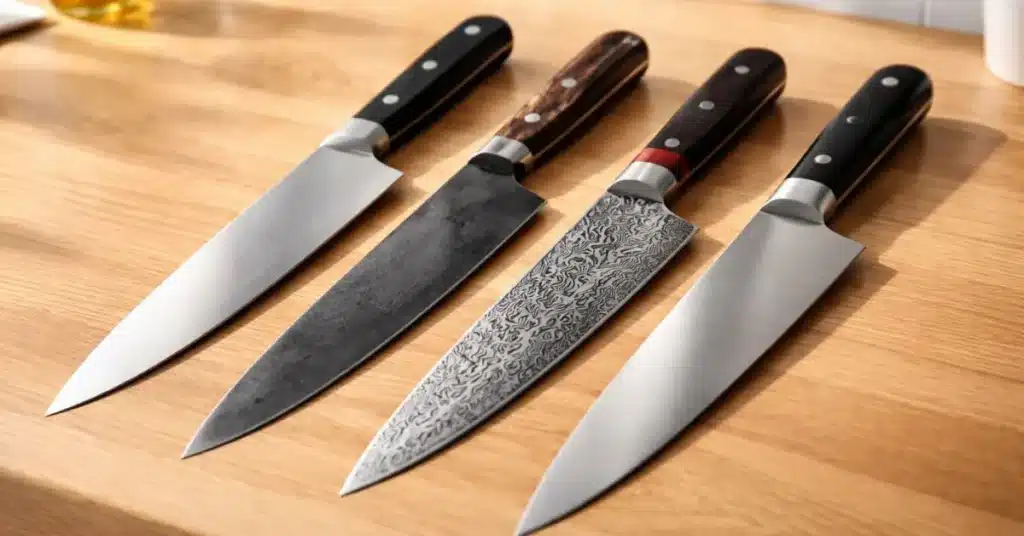
Damascus Steel
Damascus steel is known for its wavy patterns. Many people think it is special steel. But it is actually a layering method.
A real Damascus chef knife uses multiple steel layers for both design and strength. Makers forge many layers together to create the pattern.
Pros
- Beautiful look
- Often has a strong core steel
- Good performance in quality knives
Cons
- Pattern does not mean better cutting
- Some knives focus only on looks
Best For
- People who like style
- Gift knives
- Premium sets
Important truth: A Damascus knife is only as good as the steel at its center.
Powdered (Powder Metallurgy) Steel
Powdered steel is also called PM steel. Makers turn steel into fine powder first. Then they press and heat it to form a blade.
This method creates very even steel. So, the blade quality stays consistent.
Because of this, many premium knives, especially in Japanese vs Western knives
comparisons, use PM steel.
Pros
- Holds a sharp edge for a long time
- Strong cutting performance
- Very consistent quality
Cons
- Costs more than regular steel
- Takes more effort to sharpen
- Not needed for simple home cooking
Best For
- Knife fans
- Professional cooks
- People who want top performance
Simple Advice
PM steel works very well. But many home cooks do not need it.A good regular steel knife can still cook beautifully every day.
Popular Knife Steel Grades Explained
When you shop for a knife, you often see steel names in the details. These names are called steel grades. They show the exact mix of elements in the steel.
You do not need to memorize them. But knowing a few helps you buy smarter. Here are some common grades used in kitchen knives.
VG-10 Steel
VG-10 is a popular Japanese knife steel. It gives a nice mix of sharpness, edge life, and rust resistance.
Why people like it
- Gets very sharp
- Stays sharp for a long time
- Resists rust well
- Used in many Japanese knives
Keep in mind
- Slightly harder to sharpen
- Quality depends on heat treatment
Great for home cooks who want long-lasting sharpness.
AUS-10 Steel
AUS-10 is also a Japanese stainless steel. It offers good all-around performance.
Why people like it
- Good sharpness
- Fair edge life
- Strong rust resistance
- Often lower cost than VG-10
Because of this value,AUS-10 appears in many Japanese knives made for everyday cooking.
Keep in mind
- Edge life is lower than premium steels
Good for buyers who want value for money.
X50CrMoV15 Steel
This steel is common in German kitchen knives. It focuses on strength and easy care.
Why people like it
- Very rust resistant
- Easy to sharpen
- Tough and durable
- Good for daily cooking
Keep in mind
- Does not stay sharp as long
as harder steels
Excellent for busy kitchens.
1095 Carbon Steel
1095 is a classic carbon steel. It is simple but strong.
Why people like it
- Gets extremely sharp
- Easy to sharpen
- Loved by knife fans
Keep in mind
- Rusts if left wet
- Needs drying after use
Best for people who enjoy knife care.
SG2 (R2) Steel
SG2, also called R2, is a high-end powdered steel. Many premium Japanese knives use it.
Why people like it
- Very long edge life
- Very hard and strong
- Top performance
Keep in mind
- Expensive
- Harder to sharpen
- Not needed for casual cooks
Ideal for knife lovers and professional cooks.
Knife Steel Comparison Chart
If you prefer a quick overview, this chart makes things simple.
| Steel | Sharpness | Rust Resistance | Ease of Sharpening | Best For |
| VG-10 | Very high | High | Medium | Home cooks wanting sharpness |
| AUS-10 | High | High | Medium | Value buyers |
| X50CrMoV15 | Medium | Very high | Easy | Busy kitchens |
| 1095 | Very high | Low | Easy | Enthusiasts |
| SG2/R2 | Extremely high | High | Hard | Premium users |
No steel is perfect. Each has trade-offs. The best one depends on what matters more to you — sharpness, easy care, or long edge life.
You’ll see these steels used in many top kitchen knives designed for different cooking styles.
Which Knife Steel Should You Choose?
Now you know different knife steels. So the big question is simple:
Which steel is right for you?
There is no one winner for everyone. The best steel depends on:
- how you cook
- your skill level
- how much care you want to do
So, here is an easy guide.
Best for Most Home Cooks
High-carbon stainless steel
It gives a nice balance of:
- sharpness
- rust resistance
- easy care
- durability
If you cook often but don’t want extra care, this is a safe choice.
Best for Beginners
Stainless steel
Why it works well:
- low rust risk
- easy to care for
- simple to use
- easy to maintain
So you can focus on cooking, not on knife care.
Best for Sharpness Lovers
Carbon steel
It can get very sharp and cut very smoothly.
But remember:
- dry it after use
- give it more care
Good for people who enjoy knife care.
Best Low-Maintenance Option
Rust-resistant stainless steel like X50CrMoV15
Great for:
- busy kitchens
- families
- daily cooking
You may sharpen more often, but care stays simple.
Simple Truth
A good knife you care for works better than a premium knife you ignore. So choose a steel that fits your lifestyle.
If you want help choosing, many of the best kitchen knives use the steels discussed above.
And if you want a step-by-step process, this kitchen knife buying guide makes choosing easier.
So choose a steel that fits your lifestyle.
Common Myths About Knife Steel
Many people hear confusing things about knife steel. Marketing often adds hype. So, let’s clear up some common myths.
❌ Myth 1 — Harder Steel Is Always Better
Hard steel can stay sharp longer. But it can also chip more easily.
It also takes more effort to sharpen. So, knowing how often to sharpen knives helps more than chasing extreme hardness.
Balance matters more than extreme hardness.
❌ Myth 2 — Damascus Steel Is Always Premium
Damascus knives look beautiful. But looks do not decide performance.The core steel inside matters most.
A simple knife with good steel can cut better than a flashy Damascus knife.
❌ Myth 3 — Expensive Steel Means Better Cooking
A higher price does not guarantee better cooking.
Other things matter too, like:
- heat treatment
- blade design
- sharpening
A mid-range knife, well cared for, can work great.
❌ Myth 4 — Stainless Steel Never Rusts
Stainless does not mean rust-proof.It only means rust-resistant.If you leave a knife wet or dirty, it can still rust.
So, basic care still matters.
How Knife Steel Affects Sharpening and Care
Knife steel affects how often you sharpen and how much care you need.
If you want a deeper guide on tools, angles, and routines, see our knife sharpening and maintenance guide.
Some steels need more work. Others are easier to manage. So, it helps to know the difference.
Sharpening Frequency
Different steels dull at different speeds.
Harder steels
- stay sharp longer
- need sharpening less often
- take more effort to sharpen
Softer steels
- dull faster
- sharpen more quickly
- easier for beginners
So, choose what fits your routine.
Honing vs Sharpening
Many people mix these up. But they are not the same.
- Honing straightens the edge.
- Sharpening removes metal
to make a new edge.
Professional kitchens hone knives often to keep the edge aligned. You can see how chefs maintain knives.
If you hone often, you sharpen less often. So most home cooks only need full sharpening sometimes.
Rust Prevention
Good habits help any knife steel.
Simple steps:
- wash and dry after use
- don’t leave knives in the sink
- store knives safely
Carbon steel needs more care. But stainless steel also needs cleaning.
Real-World Tip
If you don’t like maintenance, keep things simple.
- Choose rust-resistant steel
- Learn basic sharpening
- Store knives safely
These habits matter more than chasing fancy steels.
FAQs About Knife Steel
What is the best steel for kitchen knives?
There is no single “best” steel for everyone. High-carbon stainless steel is a great choice for most home cooks because it gives sharpness, rust resistance, and easy care. The best steel depends on how you cook and how much maintenance you want to do.
Which knife steel stays sharp the longest?
Harder steels like SG2, R2, and well-treated VG-10 can stay sharp longer. However, they also take more effort to sharpen. For most people, a balanced steel that is easy to maintain works better than chasing extreme edge life.
Is carbon steel safe for food?
Yes, carbon steel is safe for food. Many chefs use it daily. Over time, it forms a dark patina, which is normal and can protect the blade. Just wash and dry it after use to prevent rust.
Does knife steel affect food taste?
No, knife steel does not change food taste. Modern knife steels are food safe. Taste problems usually come from poor cleaning or leftover food on the blade, not from the steel itself.
What steel do professional chefs prefer?
Many chefs like high-carbon or high-carbon stainless steel because they get very sharp and cut smoothly. Still, chefs choose steel based on their routine. In busy kitchens, easy care can matter as much as sharpness.
Is expensive knife steel worth it?
Expensive steel can offer longer edge life and strong performance. But many mid-range steels work very well for home cooking. Good technique and regular sharpening often matter more than paying for premium steel.
What is the best knife steel for beginners?
Stainless steel or high-carbon stainless steel is best for beginners. These steels resist rust and need less care. So new cooks can focus on learning skills instead of worrying about knife maintenance.
If You’re Choosing a Knife Today
If you plan to buy a kitchen knife soon, keep this simple guide in mind:
Want easy care?
Choose stainless or high-carbon stainless steel.
Want very sharp cuts?
Carbon steel or VG-10 can work great.
Want a balanced daily knife?
High-carbon stainless steel fits most homes.
A good knife with the right steel can last many years when you care for it properly.
Remember, steel is only one part of a great knife. Comfort, balance, and good habits matter too.
If you want help picking the right knife,you can explore:
- our guide to best kitchen knives
- this detailed kitchen knife buying guide
- comparisons like Japanese vs Western knife styles
The more you understand your tools, the easier and more enjoyable cooking becomes.